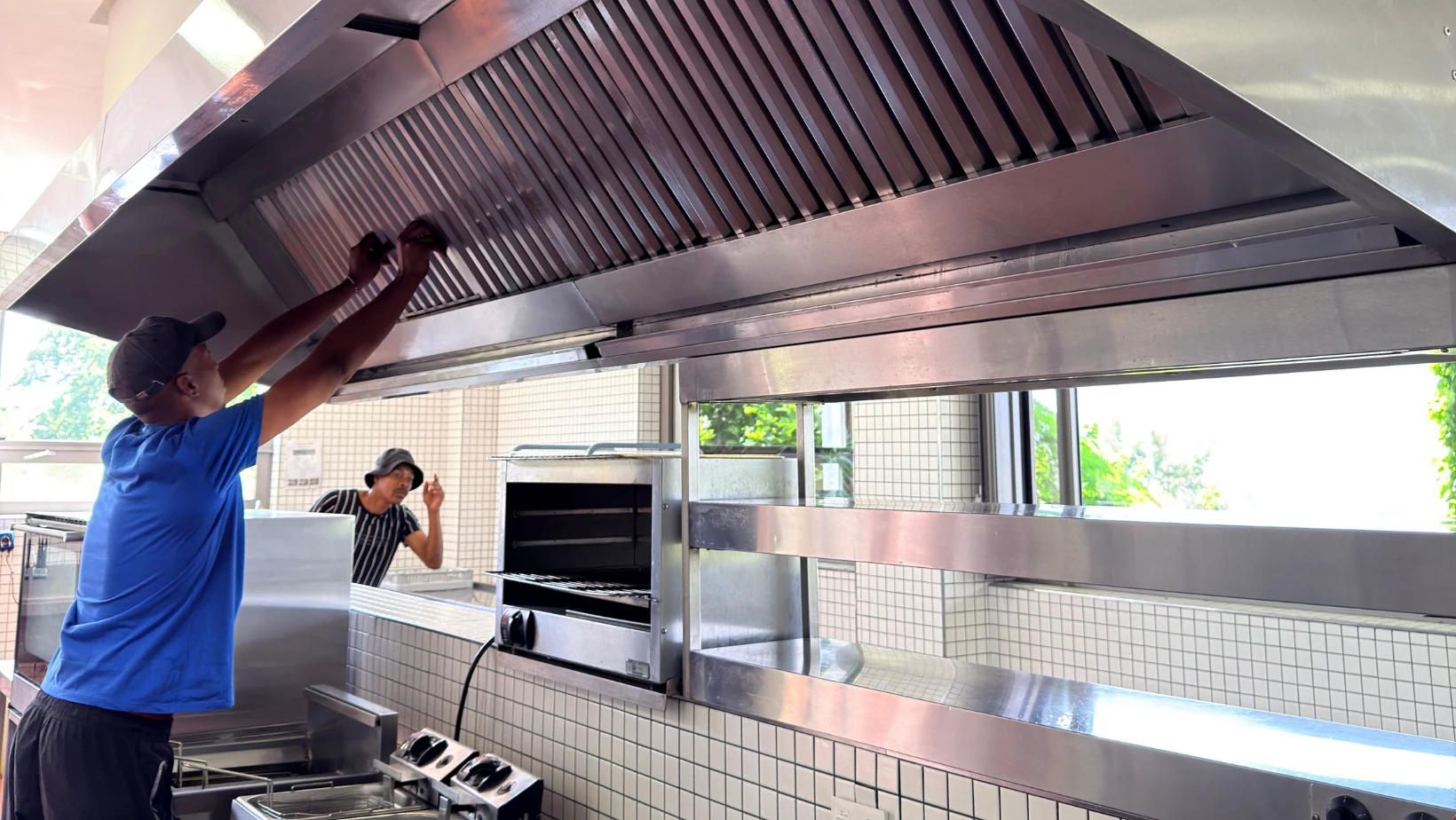
A restaurant canopy may look clean from the kitchen floor while grease is steadily accumulating inside the filters, ductwork, fan housing and extraction route above it.
That is why commercial kitchen extraction cleaning is not simply about appearance.
Grease accumulation can affect fire safety, kitchen hygiene, airflow, odour control, equipment performance and maintenance costs.
For restaurants, cafés, hotels, takeaways, bakeries and commercial kitchens in Cape Town and the Cape Winelands, the real question is therefore not:
“Does the canopy look dirty?”
It is:
“Is grease accumulating inside the extraction system faster than we are removing it?”
This guide explains how often restaurant canopies and kitchen extraction systems should be cleaned, why cleaning frequency varies, what South African requirements say and what a professional extraction clean should include.
BCPC provides professional restaurant canopy, extraction and kitchen grease cleaning as part of its specialist cleaning services. BCPC Cleaning, Hygiene & Pest Control Services
Why Do Restaurant Extraction Systems Need Regular Cleaning?
A commercial kitchen extraction system continuously draws contaminated air away from cooking equipment.
Depending on the kitchen, that air can contain:
- cooking oil vapour
- grease particles
- smoke
- steam
- heat
- airborne food residue
- carbon deposits
Some grease is captured by the filters.
Some is not.
Over time, grease can accumulate inside the canopy, filters, ductwork, fan blades, fan housing and discharge areas.
This creates several problems.
Fire risk
Grease is combustible.
The City of Cape Town’s fire-safety framework requires extractor systems and their associated filters, dampers, screens and conduits to be regularly inspected, cleaned and maintained so fatty or other combustible residues do not accumulate.
This is one of the strongest reasons not to wait until the canopy visibly looks dirty.
Grease may already be present deeper inside the ductwork.
Reduced extraction performance
As grease and dirt accumulate, they can interfere with airflow and add contamination to fans and other components.
The result can include:
- poor smoke removal
- excessive heat in the kitchen
- lingering cooking smells
- increased strain on the extraction fan
- noisy operation
Regular cleaning therefore supports both safety and equipment performance.
Hygiene
South Africa’s food-premises hygiene regulations require effective ventilation capable of removing contaminated or stale air, gases, vapours, steam and warm air so that unhygienic conditions are prevented.
A grease-laden extraction system is clearly at odds with the objective of maintaining a clean, effectively ventilated food environment.
So, How Often Should a Restaurant Canopy Be Cleaned?
There is no sensible universal interval for every kitchen.
A coffee shop preparing light meals has a completely different grease load from a steakhouse operating grills, fryers and charbroilers for 14 hours per day.
As a practical rule, BCPC recommends that commercial kitchens work from risk and usage, not simply a calendar.
A useful working schedule is:
| Kitchen use | Suggested professional cleaning interval |
| Very heavy grease production / intensive frying / chargrilling | Every 1 to 3 months |
| Heavy-use restaurant kitchen | Approximately every 3 months |
| Moderate-use commercial kitchen | Approximately every 6 months |
| Low-use kitchen | Assess at least every 6 months and clean according to condition and applicable requirements |
International industry guidance gives a similar risk-based picture. TR19 Grease guidance uses approximately 3 months for heavy-use kitchens, 6 months for moderate use and 12 months for light use, while NFPA guidance calls for more frequent grease inspections in high-volume and solid-fuel operations.
For South African operators, however, SANS 1850 is the more relevant local reference point. South African commercial-kitchen specialists and public-sector specifications referencing SANS 1850 use regular professional inspection and cleaning, commonly working on a six-month maximum routine cycle with more frequent cleaning where necessary.
The safest approach is therefore:
Never assume six months is automatically enough.
If your kitchen produces grease faster, shorten the interval.
Which Restaurants Need More Frequent Extraction Cleaning?
Certain cooking methods generate substantially more grease, smoke and particulate matter.
Frying
Deep fryers and high-volume frying operations can generate significant airborne grease.
Restaurants with several fryers operating throughout lunch and dinner service should generally expect more frequent professional extraction cleaning than a light-use kitchen.
Chargrilling and open-flame cooking
Chargrills, flame grills and similar cooking equipment produce a combination of grease, smoke and carbon.
These deposits can accumulate throughout the extraction path.
Wok cooking
High temperatures and intensive oil use can produce significant airborne grease, especially in high-volume kitchens.
Solid-fuel cooking
Wood, charcoal and other solid fuels introduce additional soot, carbon and combustion deposits.
International fire-safety guidance therefore recommends particularly frequent inspection of systems serving solid-fuel cooking.
Long operating hours
A restaurant cooking for 14 hours per day cannot reasonably be treated the same as a small café using its hot line for three hours.
Cleaning frequency should increase with operating hours and actual grease production.
Can Restaurant Staff Clean the Canopy Themselves?
Yes, but only part of it.
Routine kitchen cleaning remains important.
Restaurant staff should maintain accessible surfaces and filters according to the equipment manufacturer’s instructions and the site’s hygiene procedures.
But routine cleaning should not be confused with a full professional extraction-system clean.
The parts visible from underneath the canopy are only the beginning of the system.
Grease can continue through:
canopy → filters → plenum → ductwork → extraction fan → discharge point
Cleaning only the stainless-steel hood can therefore leave significant contamination elsewhere.
Industry guidance specifically warns that filter cleaning alone does not eliminate grease accumulation throughout the extraction system.
What Should Professional Canopy & Extraction Cleaning Include?
A proper commercial-kitchen extraction clean should address considerably more than the visible canopy.
Depending on the system and accessibility, the scope should include:
Canopy and hood
The internal and external surfaces should be degreased and cleaned.
Filters
Filters should be removed, cleaned and inspected.
Damaged, unsuitable or missing filters should be identified for replacement.
Internal ducting
Accessible vertical and horizontal ducting should be inspected and cleaned to remove accumulated grease.
Where sections cannot be accessed, this should be identified rather than ignored.
Extraction fan
Fan blades, fan housing and accessible motor areas should be checked and cleaned where appropriate.
Grease-coated fan blades can impair performance and place unnecessary strain on the system.
Grease collection areas
Grease traps, gutters and collection areas within the extraction assembly should be cleared and cleaned.
Inspection and documentation
A professional service should provide evidence of the work completed.
South African public-sector specifications referencing SANS 1850 include requirements such as canopy cleaning, duct cleaning, filter maintenance, fan cleaning, airflow checks and before-and-after photographs.
What Is SANS 1850 and Why Does It Matter?
SANS 1850 is the South African standard associated with commercial-kitchen ventilation and extraction systems.
It addresses matters including the use, inspection, maintenance and cleaning of commercial kitchen extraction equipment.
For restaurant owners, hotel managers and facilities managers, the important principle is simple:
grease must not be allowed to accumulate unchecked inside the extraction system.
Commercial-kitchen service providers across South Africa use SANS 1850 as the reference framework for extraction-system cleaning and certification.
Restaurants should also check:
- insurer requirements
- landlord requirements
- fire-risk assessments
- manufacturer recommendations
- local authority requirements
because these may require shorter maintenance intervals than a general routine schedule.
Does Cape Town Law Specify an Exact Cleaning Interval?
The City fire-safety rule is more important than simply memorising a number.
It requires the person responsible for the premises to ensure that extraction components are regularly inspected, cleaned and maintained so combustible residue does not accumulate.
In other words, allowing grease to build up and then arguing that the six-month date has not yet arrived is not a sensible compliance strategy.
Cleaning frequency should reflect the actual condition of the system.
A busy restaurant might therefore need professional cleaning every three months or even more frequently.
7 Signs Your Extraction System May Need Cleaning Earlier
Do not wait for the scheduled service if you notice:
- Visible grease on the canopy or around filters
- Grease dripping from the hood or duct areas
- Smoke lingering longer than usual
- Strong cooking odours remaining after service
- The extraction fan sounding louder or strained
- Reduced airflow or poor heat removal
- Heavy grease visible during filter removal
Any of these can indicate that the current maintenance interval is too long.
Why Cleaning Only the Filters Is Not Enough
Filters are the first line of defence, not the whole system.
Even effective filters do not capture every grease particle.
Grease can pass further into the ductwork and fan assembly.
That means a restaurant can have clean-looking filters while grease remains inside less visible sections of the extraction route.
A proper maintenance plan should therefore distinguish between:
routine filter cleaning
and:
periodic full extraction-system cleaning
Both matter.
What Records Should Restaurants Keep?
Documentation is valuable for far more than administration.
After professional extraction cleaning, retain:
- service date
- cleaning scope
- contractor details
- before-and-after photographs
- areas that could not be accessed
- defects identified
- recommended next service date
- cleaning/service certificate where applicable
South African commercial extraction contractors commonly issue cleaning certificates referencing SANS 1850, and public-sector specifications likewise call for service documentation and photographic evidence.
These records may also be useful when dealing with insurers, landlords, safety inspections or future maintenance.
Restaurant Canopy Cleaning Is Also Preventative Maintenance
A professional extraction clean is not only about removing dirt.
It gives the operator an opportunity to identify:
- damaged filters
- excessive grease accumulation
- leaks
- poor duct access
- fan contamination
- deteriorating components
- declining extraction performance
That makes scheduled cleaning part of preventative maintenance rather than simply another housekeeping expense.
How BCPC Approaches Restaurant Canopy & Extraction Cleaning
BCPC provides professional extraction and canopy cleaning for restaurants, cafés, hotels, guesthouses, commercial kitchens, canteens, takeaways and other food-service environments.
Our service can include:
- extraction canopy cleaning
- filter cleaning
- filter replacement support
- degreasing
- extraction fan cleaning
- accessible duct and extraction-area cleaning
- photographic service documentation
- scheduled preventative cleaning
You can view BCPC’s broader professional cleaning, hygiene and specialist cleaning services here:
BCPC Cleaning & Specialist Services
BCPC operates across Cape Town, Stellenbosch, Somerset West, Paarl, Franschhoek and the wider Cape Winelands.
Frequently Asked Questions
How often should a restaurant canopy be professionally cleaned?
For many commercial kitchens, three to six months is a practical professional-cleaning interval.
High-volume frying, chargrilling, wok cooking, long operating hours and solid-fuel cooking can require substantially more frequent inspection and cleaning.
The system condition should ultimately determine the schedule.
Is six-monthly cleaning enough for every restaurant?
No.
Six months should not be treated as permission to allow grease to accumulate.
A high-volume restaurant may require cleaning every three months or sooner.
Do extraction ducts also need cleaning?
Yes.
Cleaning only the visible hood and filters does not address grease that has travelled into the ducting and fan assembly.
The full accessible extraction route should form part of the inspection and cleaning strategy.
Can restaurant employees clean the extraction system?
Restaurant staff can maintain accessible surfaces and filters as part of daily or routine hygiene.
Professional deep cleaning is still required for the less accessible extraction system, ductwork and fan components.
Does kitchen extraction cleaning help prevent fires?
Removing combustible grease reduces one of the major fire hazards associated with commercial kitchen extraction systems.
Cape Town fire-safety rules specifically require regular inspection, cleaning and maintenance to prevent fatty or combustible residues from accumulating.
Does BCPC clean restaurant extraction systems?
Yes. BCPC provides restaurant canopy, filter, grease and extraction cleaning for commercial kitchens across Cape Town and the Cape Winelands.
When Was Your Extraction System Last Professionally Cleaned?
If the answer is unclear, that is a good reason to inspect it.
BCPC can assess the condition of your restaurant canopy and extraction system and help establish a sensible preventative cleaning schedule based on your kitchen’s operating hours, cooking methods and grease load.
Request a restaurant canopy and extraction cleaning assessment from BCPC.
Phone: 021 891 4886
WhatsApp: 074 331 0383